
Scholarship, Teaching & Applied Inquiry
Where evidence meets experience, and questions stay close to the people and systems they are meant to serve.
I am a scholar-practitioner, educator, advisor, and former senior higher
education leader whose work has consistently moved between inquiry and
application.
Across teaching, research, assessment, writing, and institutional practice,
I am interested in how people experience the systems we build, how leaders
make consequential decisions, and what helps students and organizations
learn, belong, adapt, and remain human.
Confer is the academic home for that work: my teaching,
advising, scholarship, current questions, public learning, and opportunities
to think and create alongside students, colleagues, and institutions.
Scholarship has always been one way I make sense of practice.
Practice, in turn, is one of the places I test scholarship. My career in higher education has given me no shortage of complicated questions about people, organizations, learning, technology, power, care, judgment, and change.
My academic preparation crosses disciplines as well. I hold a Ph.D. in
Counseling and Student Personnel Services with a Graduate Certificate
in Interdisciplinary Qualitative Studies, an M.S. in College Student
Personnel Services and Administration, and a B.S. in Computer Science
with a minor in Honors Interdisciplinary Studies.
That range shapes how I approach questions. I am interested in
evidence without losing context, systems without losing people, and
technology without surrendering judgment, dignity, authorship, or
responsibility.
The throughline
My earlier scholarship examined identity, belonging, technology, learning environments, moral reasoning, and student experience. Today, those questions continue through work on leadership, organizational well-being, assessment, human-centered AI, and the design of systems that help people remain fully human within them.
Teaching, advising, and learning alongside practitioners
My current academic work spans three connected areas: educational leadership, organizational leadership, and human-centered artificial intelligence. Through graduate teaching and doctoral advising, I stay in conversation with students and practitioners working through emerging questions and real organizational problems.
Lindenwood University
I contribute within Lindenwood's Educational Leadership programs in the College of Education and Human Services and within the Human-Centered Artificial Intelligence program in the Department of Art History, AI, and Visual Culture within the College of Arts and Humanities.
Across both spaces, I am especially interested in helping students connect research, professional and lived experience, emerging technology, and responsible judgment to meaningful problems of practice.
Maryville University
I advise doctoral students in Maryville's Doctor of Education in Organizational Leadership as they develop applied research projects around organizational problems and move those questions toward well-supported capstone studies.
My role is to help students sharpen questions, connect evidence to practice, make thoughtful methodological choices, and retain ownership of the work they are creating.
Rigor and care belong together.
I believe students learn most deeply when meaningful intellectual challenge exists alongside trust, clear expectations, substantive dialogue, and a genuine sense that they matter in the learning community.
Students bring significant professional, academic, personal, and lived
knowledge into a learning environment. I invite that knowledge into the
room while asking students to put it in conversation with research,
theory, evidence, and perspectives beyond their own.
Whether I am teaching, advising, or supporting applied inquiry, my goal
is not simply to help someone complete an assignment or earn a
credential. I want students to leave with stronger judgment, sharper
questions, greater self-awareness, and a clearer capacity to lead
meaningful change.
Challenge + Support
Learning should stretch people without abandoning them. Clear expectations, useful feedback, and meaningful intellectual challenge can coexist with genuine care.
Belonging + Difference
A strong learning community is not one without disagreement. It is one where people can question, disagree, take intellectual risks, and remain connected across difference.
Evidence + Application
Cases, reflection, assessment, policy analysis, discussion, and practitioner inquiry help students move between what scholarship says and what responsible leadership requires.
Learning is relational.
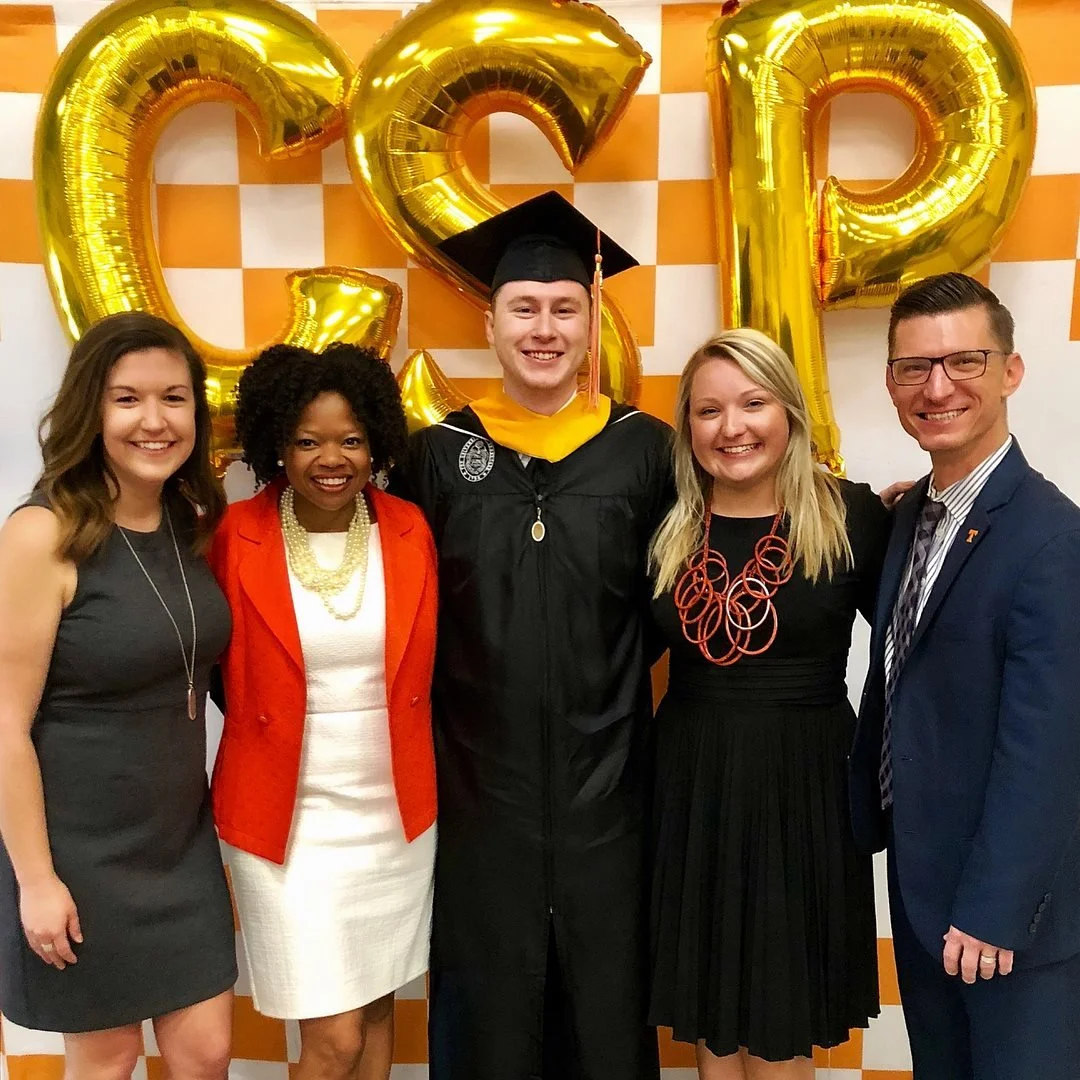
Some of the most meaningful parts of teaching happen beyond an assignment: in the questions students keep asking, the confidence they build, and the ways learning begins to shape how they understand themselves as practitioners and leaders.
Curious what learning with me feels like?
Students often encounter an instructor's credentials before they get a sense of the person behind them. This space is meant to make that distance a little smaller.
A brief welcome
I recently recorded a welcome for Lindenwood doctoral students introducing who I am, how I approach teaching and advising, and some of what I hope students experience when we work together.
Explore educational videos on YouTube →Across graduate, undergraduate, and professional learning
My teaching has included educational leadership, student affairs, assessment and program evaluation, helping skills, leadership education, and first-year transition.
The University of Tennessee, Knoxville
ELPS 595 Special Topics: Critical Issues in Student Affairs
The University of Georgia
ECHD 7460: Issues in Student Affairs Administration
ECHD 7770: Assessment and Program Evaluation
ECHD 3010: Paraprofessional Helping Strategies
Oglethorpe University
The Role of a Liberal Arts College
Lead 101: The Strength of Leadership
Oglethorpe 101
Elon University
Elon 101: First-Year Transition Seminar
Developmental academic advising for first-year students
Strengthen the question without taking ownership of it.
I approach advising as a partnership in scholarly development. My role is to help students ask stronger questions, align their choices with those questions, use evidence responsibly, and build work they can explain and defend as their own.
Doctoral Dissertation-in-Practice
I have served on Ed.D. dissertation-in-practice committees examining student-athlete philanthropy, transitions from sport to career, and the experiences of LGBTQ+ student-athletes.
Master's Capstone Projects
I have served on master's capstone committees addressing Panhellenic retention, social justice education, mentoring, graduate-school access, transfer orientation, and free speech and civility education.
An evolving program of questions
The topics have evolved across my career, but the underlying questions remain connected: how do environments, technologies, leadership choices, identities, and organizational systems shape people's ability to belong, exercise agency, learn, make meaning, and remain human?
Human-Centered AI & Judgment
How can AI support analysis, creativity, learning, and efficiency without quietly displacing human judgment, accountability, authorship, dignity, or care?
Belonging & Student Experience
What conditions strengthen mattering, connection, participation, and belonging across physical, digital, hybrid, and organizational spaces?
Leadership & Organizational Well-Being
How do leadership practices, structures, culture, pace, and finite human capacity shape trust, sustainability, change, and organizational life?
Assessment & Evidence-to-Action
How can assessment move beyond compliance and become a useful way to learn, make decisions, improve programs, tell more truthful stories, and change systems?
Identity, Equity & Lived Experience
How do identity, power, context, difference, and lived experience shape access, development, leadership, belonging, and institutional experience?
Student Affairs & Higher Education
How can institutions design learning and support environments that strengthen student development, engagement, persistence, and the relationships through which education becomes meaningful?
Let the question help determine the method.
My formal preparation includes a Graduate Certificate in Interdisciplinary Qualitative Studies, while my scholarly and assessment work has also included quantitative, mixed-methods, evaluative, and applied approaches. I do not treat methodology as an identity. The aim is to choose approaches that fit the question while preserving context and intellectual honesty.
Interpret
Qualitative inquiry, lived experience, narrative, context, meaning, identity, and the human dimensions that numbers alone can miss.
Measure
Quantitative inquiry, assessment, learning outcomes, patterns, participation, program evaluation, and evidence for improvement.
Integrate
Mixed methods, applied research, triangulation, evaluation, and approaches that connect multiple forms of evidence to consequential decisions.
Watch: Triangulation in Qualitative Research →Where some of these questions began
Physical and Virtual Safe and Brave Spaces for LGB College Students
My doctoral work examined physical and virtual environments in relation to safety, identity, connection, and belonging for LGB college students. Those questions continue to echo in my current interest in how people experience digital environments, institutional systems, emerging technologies, and the conditions under which they can participate fully.
Read the dissertation →Watch the Three Minute Thesis →
Earlier scholarship, continuing questions
Selected academic publications reflecting longstanding interests in identity, belonging, technology, student development, moral reasoning, and the ways research itself frames whose experience and knowledge count.
Thinking Outside the Binary Box: Queer(ing) Research and Practice
In Wynne & Gonzalez (Eds.), Who Really Speaks for Justice.
View the book →Faith and Sexual Orientation Identity Development in Gay College Men
Journal of Student Affairs Research and Practice, 52(4), 374–386.
View the ERIC record →Influence of Alternative Break Program Participation on College Students' Development of Moral Reasoning
Georgia Journal of College Student Affairs, 29(1).
Read the full article →LGBTQ Students and Internet Technology
Journal of Technology in Student Affairs.
Scholarship in conversation
Selected conference presentations, webinars, workshops, and institution-based learning experiences trace an evolving body of work across assessment, identity, organizational life, leadership, belonging, and sustainable practice.
Contributing to the communities that shape the field
Scholarship and teaching also involve stewardship: reviewing, advising, convening, serving, and helping strengthen the professional and academic communities in which knowledge is created and used.
ACPA
Former Directorate Board member with the Commission for Assessment and Evaluation, along with conference, career, and professional service roles.
Georgia Journal of College Student Affairs
Former Editorial Board member supporting scholarship in college student affairs and higher education practice.
LGBTQ+ Higher Education Field
Former Chair for Membership, Structure, and Process with the Consortium of Higher Education LGBT Resource Professionals.
Institutional Governance
Service across academic and administrative searches, student-success initiatives, assessment, strategic planning, diversity and intercultural work, and university governance.
Read. Watch. Learn.
Not all meaningful learning lives behind a journal paywall or inside a university course. I also translate research, practice, and emerging ideas into public writing, video, lessons, workshops, and applied tools.
Read
Essays, research-informed field notes, practical frameworks, and The HeartWired™ Beat on leadership, belonging, AI, and organizational life.
Explore Insights →Watch
Educational and coaching videos, program excerpts, teaching content, and practical conversations designed for learning on demand.
Visit YouTube →Learn With Me
Join live Lightning Lessons, applied labs, workshops, recordings, and evolving cohort-based learning experiences.
Explore Maven →Inquiry gets better in conversation.
Confer is also an invitation. I welcome thoughtful conversations with students, faculty colleagues, researchers, academic programs, and institutional partners whose questions intersect with this work.
Students & Advisees
Capstone and dissertation thinking, applied inquiry, methodological alignment, leadership reflection, and conversations that help move a meaningful question forward.
Faculty & Researchers
Collaborative scholarship, co-inquiry, research design, writing, presentations, assessment, and interdisciplinary conversations.
Programs & Institutions
Guest teaching, academic panels, curriculum conversations, applied assessment, research partnerships, and scholar-practitioner collaboration.
Have a question worth thinking about together?
You do not need a polished proposal before reaching out. If you are shaping a study, exploring a collaboration, thinking through an assessment question, or looking for a scholar-practitioner partner, we can start with the question and see where it leads.
Start a Scholarly Conversation